

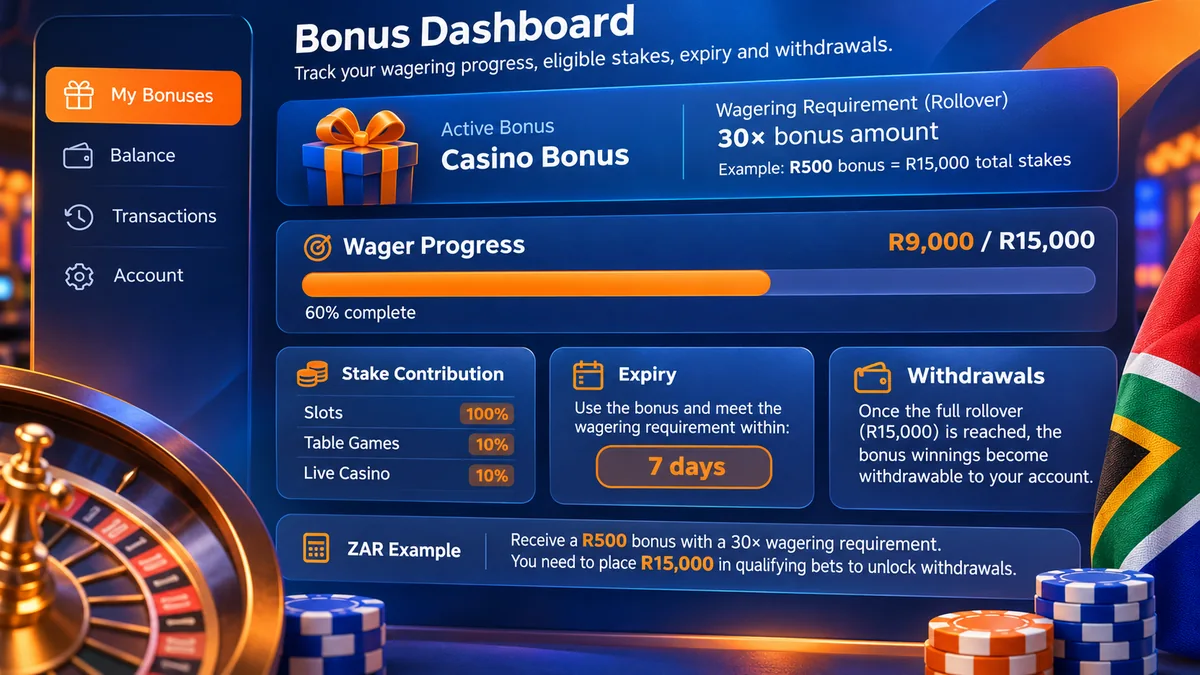
A wagering requirement is the amount of qualifying betting turnover needed before promotional funds or winnings linked to a bonus can be withdrawn. Bookmakers express it as a multiplier such as 5x, 10x or 30x. A R200 bonus at 5x requires R1,000 in eligible stakes when the multiplier applies to the bonus alone. The target is not an amount you must win or lose; it is the total value of bets that count under the promotion's rules.
The multiplier is only the starting point. Two bonuses carrying the same 5x label can have radically different withdrawal conditions if one includes the deposit, restricts minimum odds, excludes certain markets or expires earlier. For a South African punter, the useful question is not simply “How big is the bonus-” but “How much qualifying turnover is required, how is it counted, and what happens to my cash if I do not complete it-”
What does 5x, 10x or 30x wagering mean-
The number preceding the “x” is the rollover or playthrough multiplier . It applies to a defined wagering base: the bonus amount, the deposit, or the combined deposit and bonus. “Turnover” refers to money staked, including qualifying losing bets, not the profit made from them. Re-staking winnings adds new turnover if those bets meet the rules and are counted by the bookmaker.
Wagering target = wagering base × multiplier.
| Requirement | Calculation | Qualifying turnover required |
|---|---|---|
| 1x | R200 × 1 | R200 |
| 5x | R200 × 5 | R1,000 |
| 10x | R200 × 10 | R2,000 |
| 20x | R200 × 20 | R4,000 |
| 30x | R200 × 30 | R6,000 |
| 50x | R200 × 50 | R10,000 |
These figures assume that every stake contributes 100% and there are no excluded bets. Turnover measures activity, not a guaranteed return. Your available balance may run out before the target is reached, even after several winning bets.
Bonus-Only vs Deposit-Plus-Bonus Calculations
A welcome bonus or deposit-match promotion may advertise “100% up to R1,000”. That describes the size of the potential reward, not its cash value. Consider a R500 first deposit matched with R500 of bonus credit. Both offers below carry 5x wagering, yet their targets differ by R2,500.
| Terms | Wagering base | Total target |
|---|---|---|
| 5x on bonus only | R500 bonus | R2,500 |
| 5x on deposit + bonus | R500 + R500 | R5,000 |
| 10x on bonus only | R500 bonus | R5,000 |
| 10x on deposit + bonus | R500 + R500 | R10,000 |
Look for the exact wording “bonus amount”, “qualifying deposit”, “deposit and bonus”, or “total bonus balance”. Those terms identify the calculation base. A deposit may also carry a separate minimum turnover condition under the operator's general account rules, distinct from the promotional rollover. The same deposit should not be assumed to count twice or in a particular order without a rule saying so.
Wagering the funds is not the same as losing the funds. A R100 stake that loses adds R100 of qualifying turnover if the bet meets the terms. A R100 stake that wins can also add R100, while the resulting return changes the balance available for subsequent bets. The bookmaker's contribution rules and settlement system determine the recorded progress.
Which bets count towards wagering requirements-
Sports bonus rules often use the expression qualifying bet . Only eligible bets contribute to the wagering target. A bookmaker may exclude a bet entirely, count only the first qualifying wager on a particular event, or require a final settlement before the stake is recorded.
Minimum odds and sportsbook markets
Minimum odds set the lowest decimal price accepted for rollover purposes. A promotion specifying minimum odds of 1.60 would not credit a single bet at 1.40, even if it wins. Some offers impose different tests for singles and accumulator or multi-bets: a minimum total price, a minimum price for each leg, or both. A bet builder, system bet or same-game multiple is not automatically eligible just because its displayed total odds exceed the threshold.
Eligible products and exclusions can cover pre-match sports betting, live or in-play markets, horse racing, virtual sports, Lucky Numbers, handicaps, over/under selections and other special markets. The conditions might exclude particular sports, market types, promotional odds boosts or bets placed with an existing free-bet token. Read the market restrictions alongside the minimum-odds rule; one compliant number cannot override an excluded selection.
Settled, voided and cashed-out bets
Settled bets are bets with a final outcome recorded by the operator. Some South African bookmakers count rollover only after settlement. A pending bet can leave your progress unchanged until the event finishes. A voided or cancelled wager usually does not contribute, and a cash-out or partial cash-out can be excluded even though the original bet was accepted. Repeated bets on the same event or related markets may also fail to qualify.
These restrictions matter when a deadline is close: a bet placed before midnight might settle after the promotional expiry time. The offer must specify whether the clock applies to placement, settlement or completion of the rollover target.
Game contribution percentages and the effective rollover
Promotions covering gaming products may assign different wagering contribution percentages to each eligible product. A R100 stake at 100% contribution advances the wagering counter by R100. At 50%, the same stake advances it by R50. At 10%, only R10 counts. A listed game with 0% contribution adds nothing.
As a calculation exercise, a R300 bonus at 10x creates a R3,000 turnover target. If every eligible bet contributes only 50%, a total of R6,000 in stakes would be needed to record R3,000 of progress. At 10% contribution, it would take R30,000 in stakes. Actual contribution schedules may differ by product, title and promotion.
Terms may refer to slots, reels, table games, blackjack, roulette, baccarat, poker, Sic Bo, live dealer products, game shows, free spins, crash games or Aviator. These labels explain a possible contribution schedule; they do not establish that every advertised online game is legally authorised in South Africa. The operator's provincial licence and the regulated betting product take precedence over marketing labels.
How to track the wagering still outstanding
A reliable progress check uses eligible settled stakes multiplied by their contribution rates , rather than total deposits, gross winnings or the number of betting slips submitted.
Suppose the target is R1,000. Qualifying settled bets worth R250 contribute 100%, while a further R200 of eligible stakes contribute 50%. Recorded progress is R250 + R100 = R350; the outstanding turnover is R650 . An additional R100 bet on an excluded market would not reduce that balance. The example assumes no bonus-specific cap on contributions.
Many bookmakers provide a bonus-information screen or a rollover progress indicator inside the account. Compare that figure with the bet history, settlement timestamps, eligible market rules and the balance in each wallet. If the figures differ, the key question is which particular stake failed to qualify, rather than whether the account has shown a net loss.
Free bets, free spins, cashback and other promotions
Not every promotion creates the same sort of wagering obligation. The reward's form changes which amount is used in the calculation, what can be withdrawn and whether a new deposit is necessary.
- Welcome and reload deposit bonuses: a percentage of a qualifying first or subsequent deposit is credited as bonus funds. The terms define the minimum deposit, maximum bonus, multiplier, cash/bonus wallet rules and expiry.
- Free bets or bonus bet tokens: the token is often not withdrawable. A stake-not-returned (SNR) free bet pays only the profit on a winning selection. A R100 SNR token at decimal odds of 3.00 yields R200 in winnings, not R300. Whether those winnings are immediately withdrawable is a separate condition.
- No-deposit bonuses: signup credit can still carry turnover requirements, a maximum conversion amount, eligibility checks or a deposit requirement before withdrawal. “No deposit to receive” does not necessarily mean “no deposit to cash out”.
- Free spins or bonus spins: some promotions attach playthrough to the cash won from the spins, rather than to the number of spins. A R120 spin win at 10x would create a R1,200 target if those are the specified terms.
- Cashback, bet insurance and odds boosts: compensation may be paid as withdrawable cash, restricted credit or a free-bet token. A promotion described as “cashback” is not automatically wagering-free.
- Loyalty rewards and staged welcome packages: individual instalments can have separate activation steps, rollover targets, eligibility conditions and deadlines.
A no-wagering bonus has no promotional turnover target under its stated terms. Age verification, payment checks, withdrawal rules and any separate deposit turnover policy can still apply. “No wagering” should not be read as “instant payout without conditions”.
When does a bonus become withdrawable-
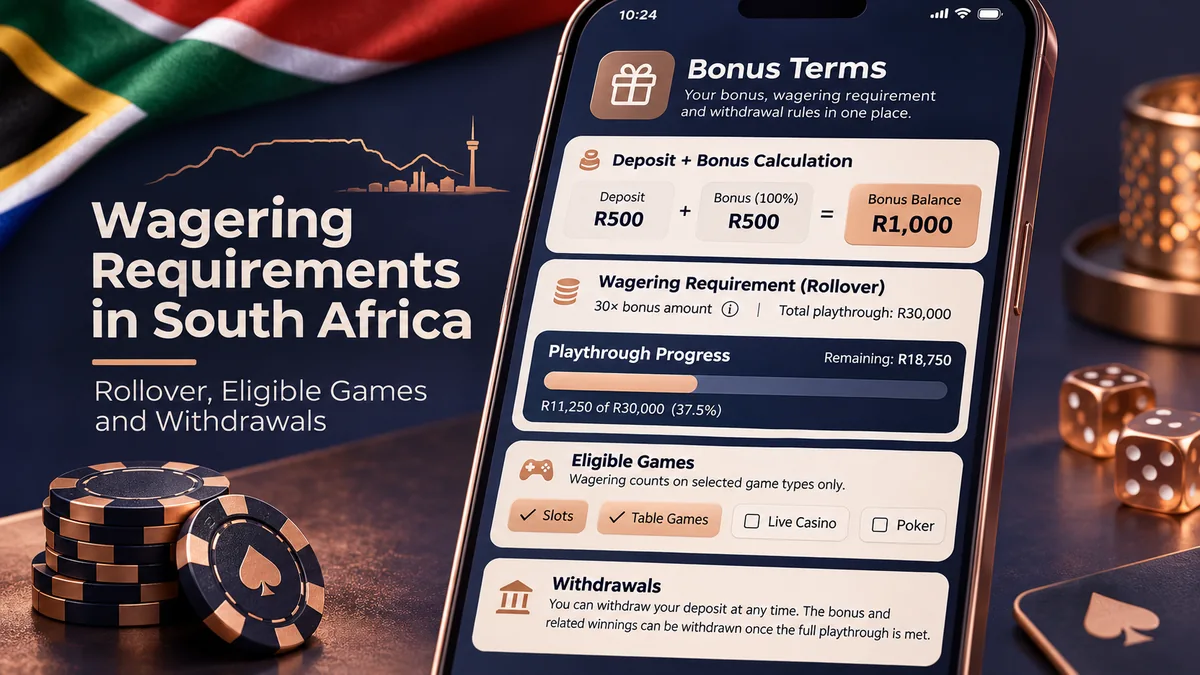
A betting account can have a cash balance , a sports bonus wallet , a games bonus wallet and an unsettled-bets balance. Some bookmakers use cash first when funding bets and credit particular winnings back to the wallet that supplied the stake. The displayed account total may exceed the money available for withdrawal.
After a promotion's rollover is completed, its rules govern whether the remaining bonus and associated winnings are transferred to the main cash wallet, whether the bonus principal disappears, and whether a maximum conversion or maximum winnings cap applies. A maximum cash-out from bonus winnings is different from the bookmaker's standard daily withdrawal limit or maximum payout per bet.
Withdrawing your own deposit early is a separate decision from withdrawing bonus winnings. Some terms allow the cash balance to be withdrawn but cancel the active bonus and its linked winnings. Others impose a deposit playthrough check or suspend payments while identity checks are outstanding. Never infer that the bonus wallet and the deposited cash are legally or contractually interchangeable.
For South African customers, identity and payment verification may involve KYC (Know Your Customer) and checks linked to the Financial Intelligence Centre Act (FICA) . Operators can request a South African ID or other accepted identification, proof of address, payment verification or proof that a bank account belongs to the account holder. FICA controls and bonus wagering conditions serve different purposes: there is no single FICA rule that sets a universal 5x, 10x or 30x promotional multiplier.
Five clauses that can block a payout after plenty of betting
- Expiry: the wagering deadline may start when a bonus is credited, activated or claimed. Uncompleted bonuses and associated winnings can expire even while funds remain in the bonus wallet.
- Maximum stake per bet: placing a larger wager than the bonus limit allows can breach the promotion even when the bet wins. A maximum bet is not the same as a maximum cash-out.
- Conversion and payout caps: the maximum withdrawable amount from a promotion can be much lower than the bonus wallet's peak balance.
- Bonus abuse and restricted patterns: operators may prohibit hedging, opposite-outcome bets, arbitrage, linked-account betting, collusion, irregular staking patterns or attempts to bypass qualifying-odds rules.
- Eligibility and wallet restrictions: promotional opt-in, a bonus code, one account per person or household, qualifying payment methods, minimum deposits and KYC status can affect whether a reward remains valid.
The maximum win , maximum redemption and maximum withdrawal labels may refer to different caps. An offer can limit the amount converted from bonus credit while the cash wallet is subject to a separate withdrawal schedule. Check the definitions, not just the amounts.
Is a low wagering multiplier always better-
Not on its own. A 3x bonus requiring high-priced multi-bets with a short expiry may impose more risk than a 5x offer that accepts the player's normal qualifying singles and gives more time. A 5x offer applied to deposit plus bonus can require the same turnover as a 10x bonus-only offer. Partial game contribution, maximum bets and cash-out caps can reverse a comparison again.
High turnover is not a promise of value. Every new bet exposes money to another uncertain result; the bookmaker's margin and the rules of the game affect the financial risk, while volatility determines how widely short-term outcomes can vary. Betting more to “unlock” a reward can consume more funds than the reward is worth. A deadline should never be treated as a reason to raise stakes or chase losses.
| Question | What the answer changes |
|---|---|
| Does the multiplier include the deposit- | The rand value of the total turnover target. |
| Are the odds and markets acceptable- | Which bets can reduce the outstanding turnover. |
| Do contributions differ by product- | The effective turnover needed to reach the stated target. |
| When must bets settle- | Whether pending bets can clear the requirement before expiry. |
| What happens on an early withdrawal- | Whether bonus funds and linked winnings are forfeited. |
| What is the maximum bonus conversion- | The cash value that could remain after completing the terms. |
South African licensing and consumer protection
South Africa's National Gambling Board (NGB) distinguishes lawful online betting through South African-licensed bookmakers from prohibited online interactive casino gambling. The National Gambling Act, 2004 and provincial gambling laws govern this distinction. A website's use of “casino”, “slots” or “games” in promotional language is not proof of legal authorisation for every product it advertises.
A licensed bookmaker should identify its provincial licensing authority, such as the Western Cape Gambling and Racing Board or another relevant provincial regulator. The licence information and the conditions governing the exact betting product matter more than a site's advertising or an offshore licence. Online betting is restricted to people aged 18 or older .
A disputed rollover calculation is best assessed against the promotion's original terms, the bet history, settlement records, bonus-wallet transactions and any saved screenshots of the offer. A complaint can be raised with the bookmaker and then with its provincial gambling board if unresolved, following the regulator's process. If gambling is causing financial or personal harm, the National Responsible Gambling Programme provides assistance on official 24-hour toll-free helpline . Self-exclusion is also available.
Frequently asked questions
Winnings tied to a restricted bonus normally remain unavailable until qualifying rollover is complete. A separate cash balance may be withdrawable under the account rules, but requesting it can cancel an active bonus and associated winnings. Verification or payment checks can cause further delays.
Yes, if they meet the promotion's eligibility rules and the bookmaker counts them at settlement. A losing R100 qualifying stake can add R100 of turnover at 100% contribution. The loss still reduces the money available to place future bets.
Not automatically. Rollovers are based on eligible stakes, not the size of a possible payout. Accumulators may be subject to a total minimum price, minimum odds for each leg, excluded markets and limits on repeated or related selections.
The remaining bonus and winnings attached to it can be forfeited at expiry. Terms differ over the treatment of open bets, deposits and funds already converted to cash. The stated expiry time and settlement rule control the outcome.
No. “No deposit” describes how a reward is received; “no wagering” describes whether it has a rollover target. A no-deposit reward can carry a high playthrough requirement, a cash-out cap and a later deposit condition. A no-wagering reward can still require identity verification.
The displayed total may include restricted bonus credit, pending winnings, funds allocated to open bets or money awaiting verification. Check the cash wallet separately from the bonus balance and the unsettled-bets list. A completed rollover is only one of the conditions that can affect payment.
Promotional terms often reserve amendment rights, subject to applicable law and the operator's own contract. Keeping a dated copy of the specific offer and its general terms makes it easier to identify what was presented when the bonus was accepted. Disputes should be evaluated against those records and the licensing authority's rules.